Recipe
Shaker Lemon Pie
Lauren Hildreth
“Spectacular.”
— Martha Stewart
“Extraordinary.”
— Samin Nosrat
This pie is very special to me. For more than fifteen years, I’ve made it for holidays and dinner parties, always to rave reviews and requests for an encore. My husband’s aunt would have me bake it for every holiday but fears that excessive. One friend, when I’ve met new people at her parties, tells a story about the time I brought the pie to the Thanksgiving gathering where we met. Even my mother has nice things to say about it. People are always surprised it’s made with whole lemons; they feel it should be more complicated than that. Often they’ve never had anything like it, and yet they say it feels familiar—like the way you always want lemon meringue pie to be, or like the best lemon bar you’ve ever tasted.
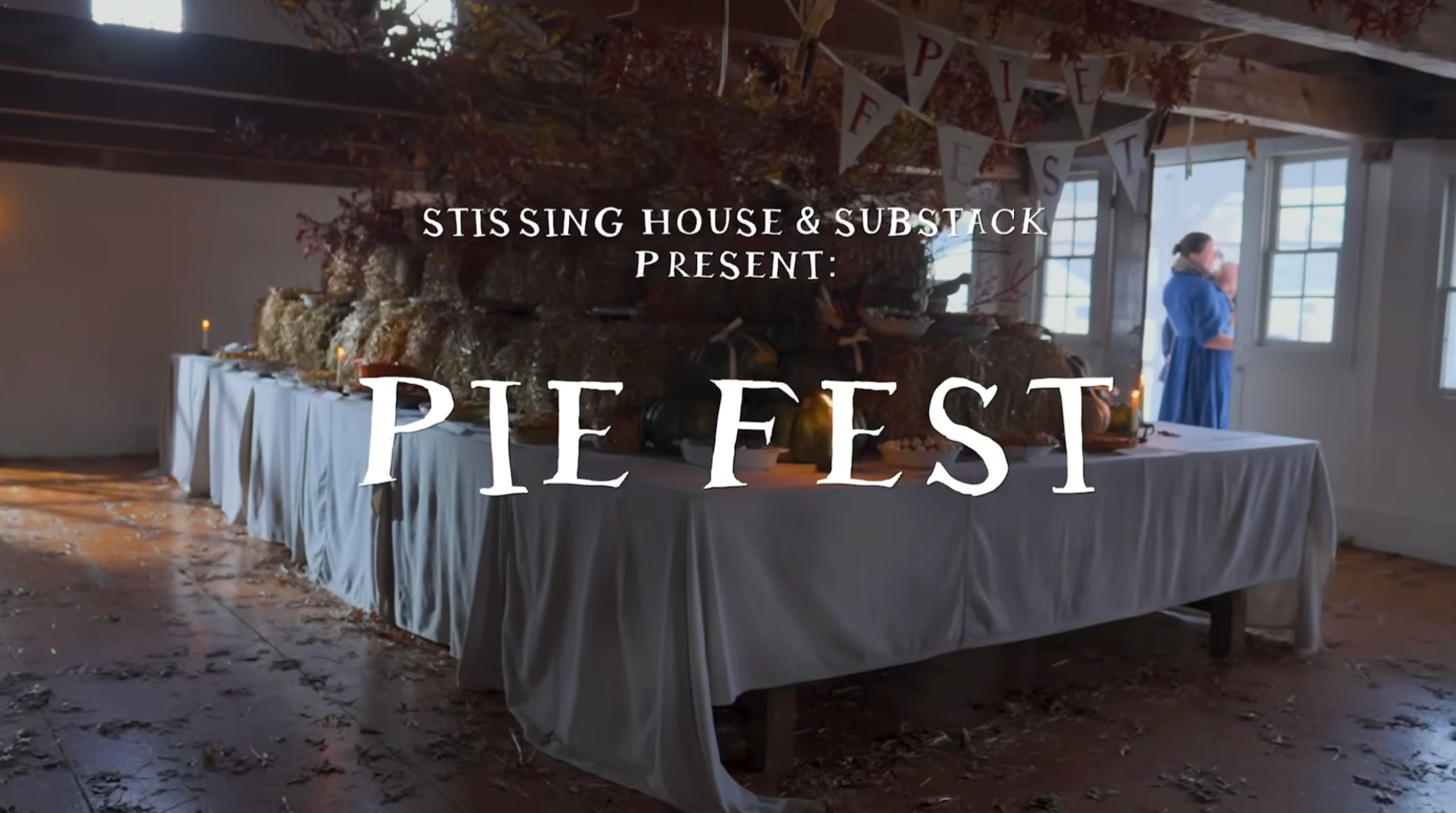
Last summer when I learned about Pie Fest, the competition that Pine Plains restaurant Stissing House would hold in November, I knew this was the pie I’d submit. Not being a “pie contest person” (or even one who would say she “loves baking”—but that’s another story), I wasn’t so interested in the competition as the chance to participate in the ethos that chef Clare de Boer has cultivated with Stissing House. I knew she’d assemble a panel of judges whose taste I shared and that the event would be the right sort of place for this pie. Indeed, when I set down my pie on the table, someone said, “That’s a real Stissing House pie!” Out of 33 entries, it ended up winning Second Place, Best in Show, and Best Crust.
While the pie originated with the Shakers, it is through Liz Prueitt’s book Tartine that I became acquainted with it. The pastry chef of San Francisco’s epoch-forging bakery Tartine, Prueitt shaped my early sense of how desserts and pastry ought to be: confident yet restrained, essentialist yet exuberant, a little overbaked and a little under-handled. There are a few people to whom I owe a debt of gratitude for teaching me to bake, and through her bakery and book Pruiett is one of them, although we’ve never met. Others include Deb Perelman, whose blog Smitten Kitchen taught me how editing and refining a recipe can transform it, and Martha Stewart, whose television show I consumed daily as a child and whose book Pies & Tarts includes a recipe for Shaker Lemon Pie. She was a surprise judge, if you can believe it, but even more surprising was her describing my pie as “spectacular,” a moment I won’t soon forget.
Even having made this recipe dozens of times, refining it with each pass, I can’t get enough of it. When you make it you’ll understand why, and I hope you feel the same.
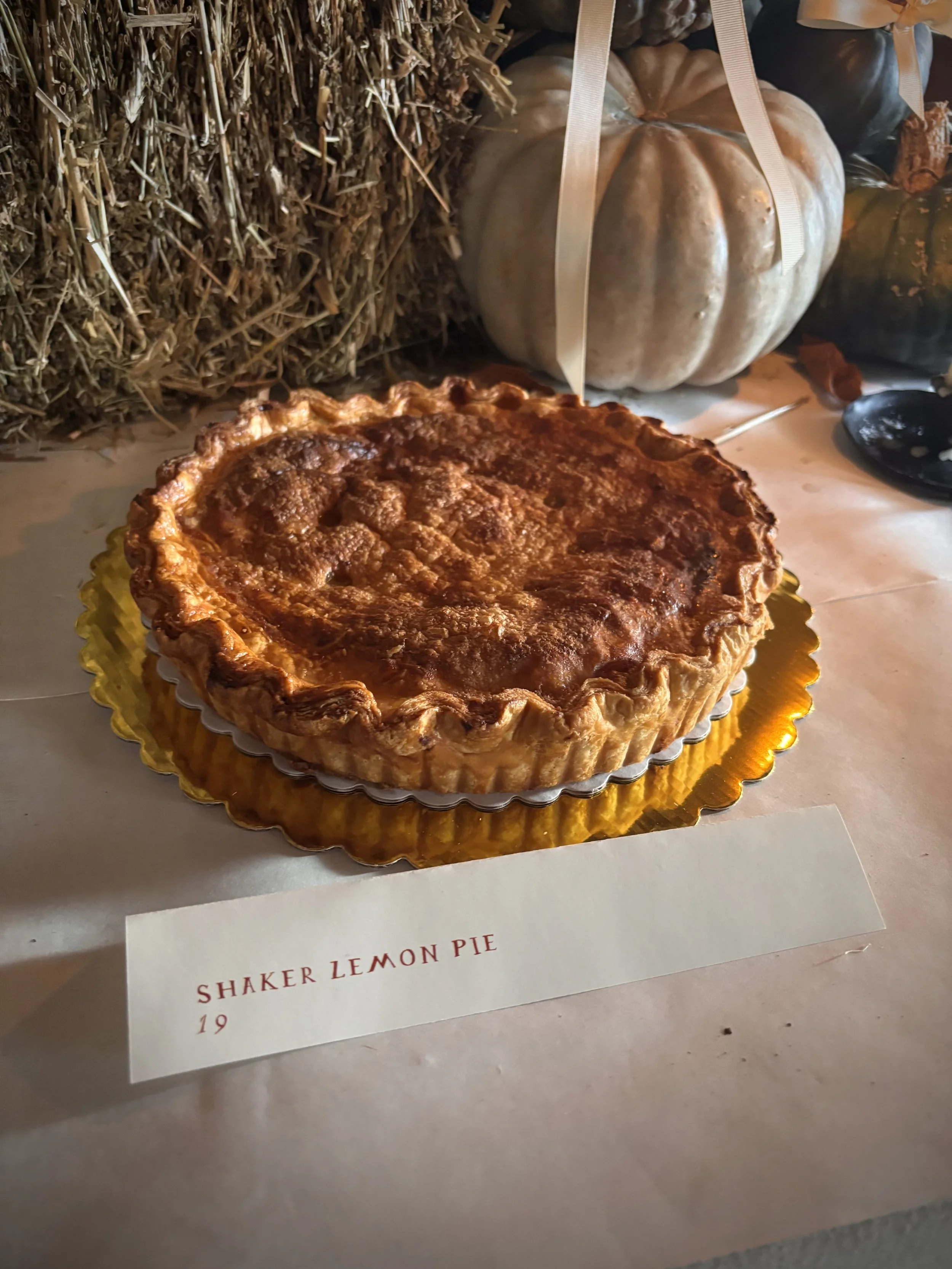
Each person baked three pies for the competition: One for display, one for the judges to taste, and another “reference pie” for the conclave. To ease the pressure of making each one perfect, I made four and chose the three best. Arguably more work but I think my pies turned out better for it!
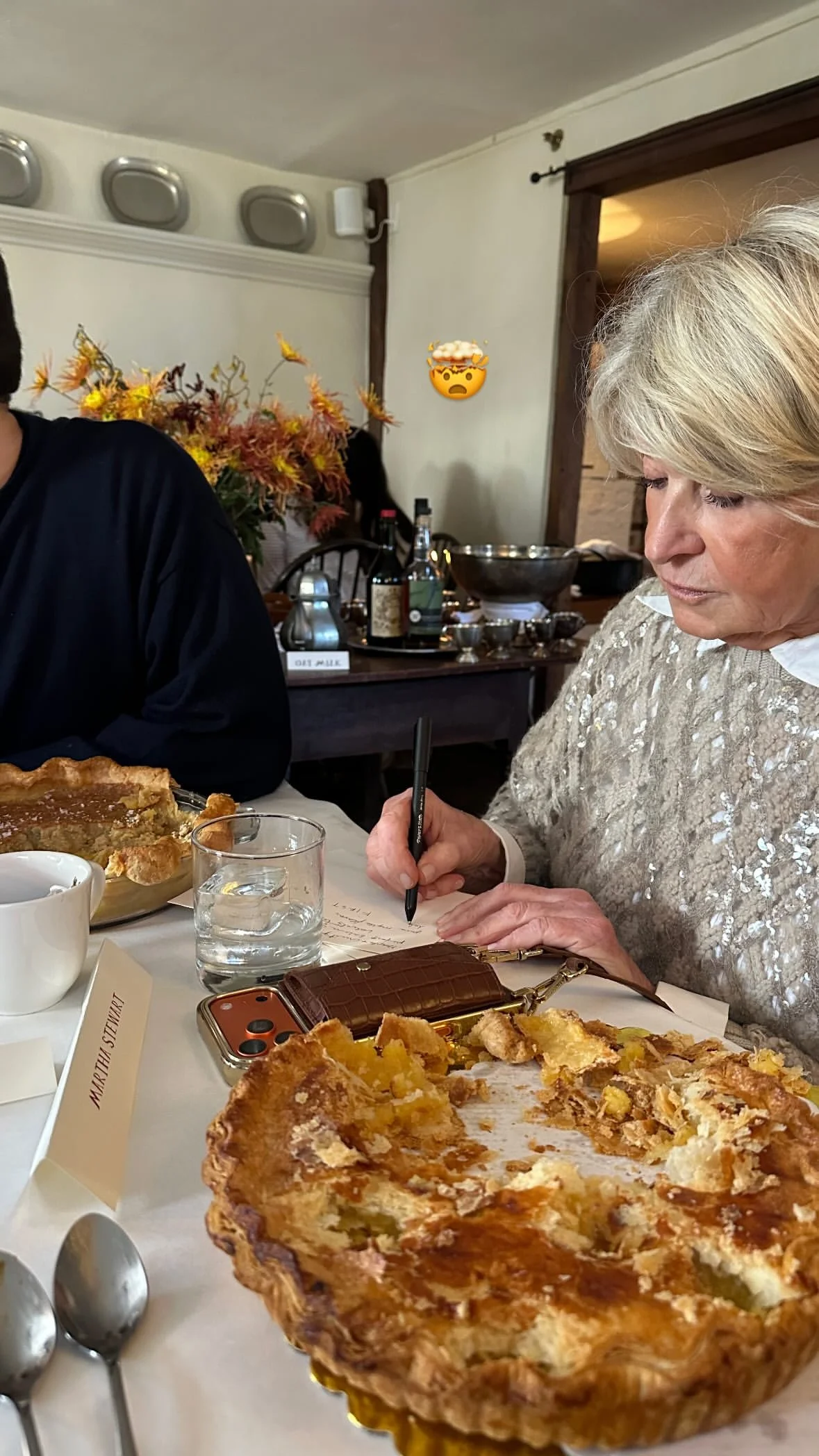
One of my pies and her best friend Martha in the judges’ conclave. Photo by Hannah Goldfield.
A few kind words from the judges
“spectacular” “confident” “extraordinary” “lemon-perfect” “elegant” “incredible”
THE INTREPID JUDGES
Tamar Adler, Greta Caruso, Rebecca Ellis, Hannah Goldfield, Lidey Heuck, Katie Kitamura, Ignacio Mattos, Samin Nosrat, Dan Pelosi, Claire Saffitz, Jessie Sheehan, Aminatou Sow, Emily Weinstein, Martha Stewart
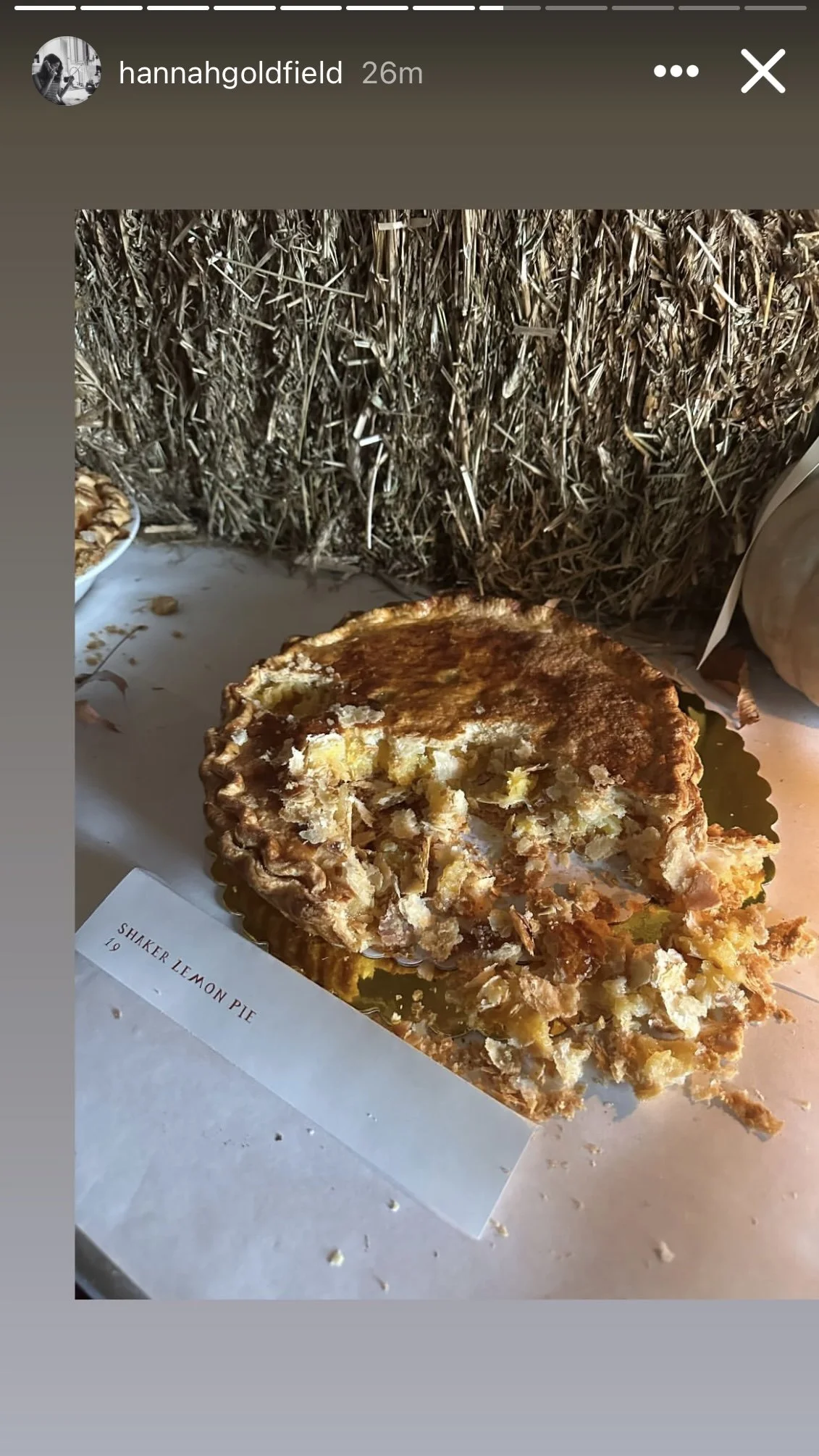
New Yorker food culture and restaurant critic Hannah Goldfield pulled me aside to say my pie was her favorite.
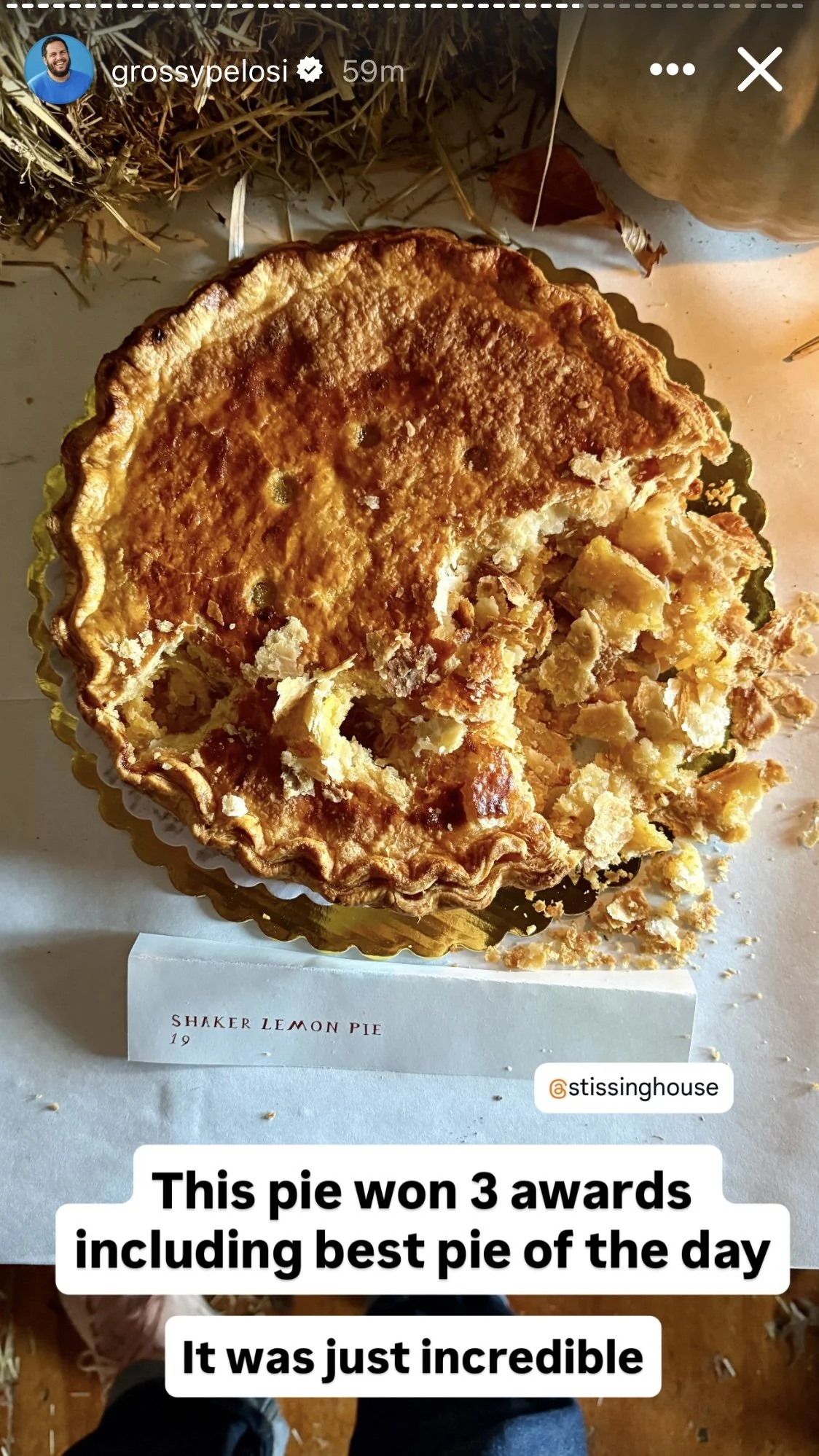
NYT bestselling author and Hudson Valley local Dan Pelosi was full of compliments when we chatted afterward.
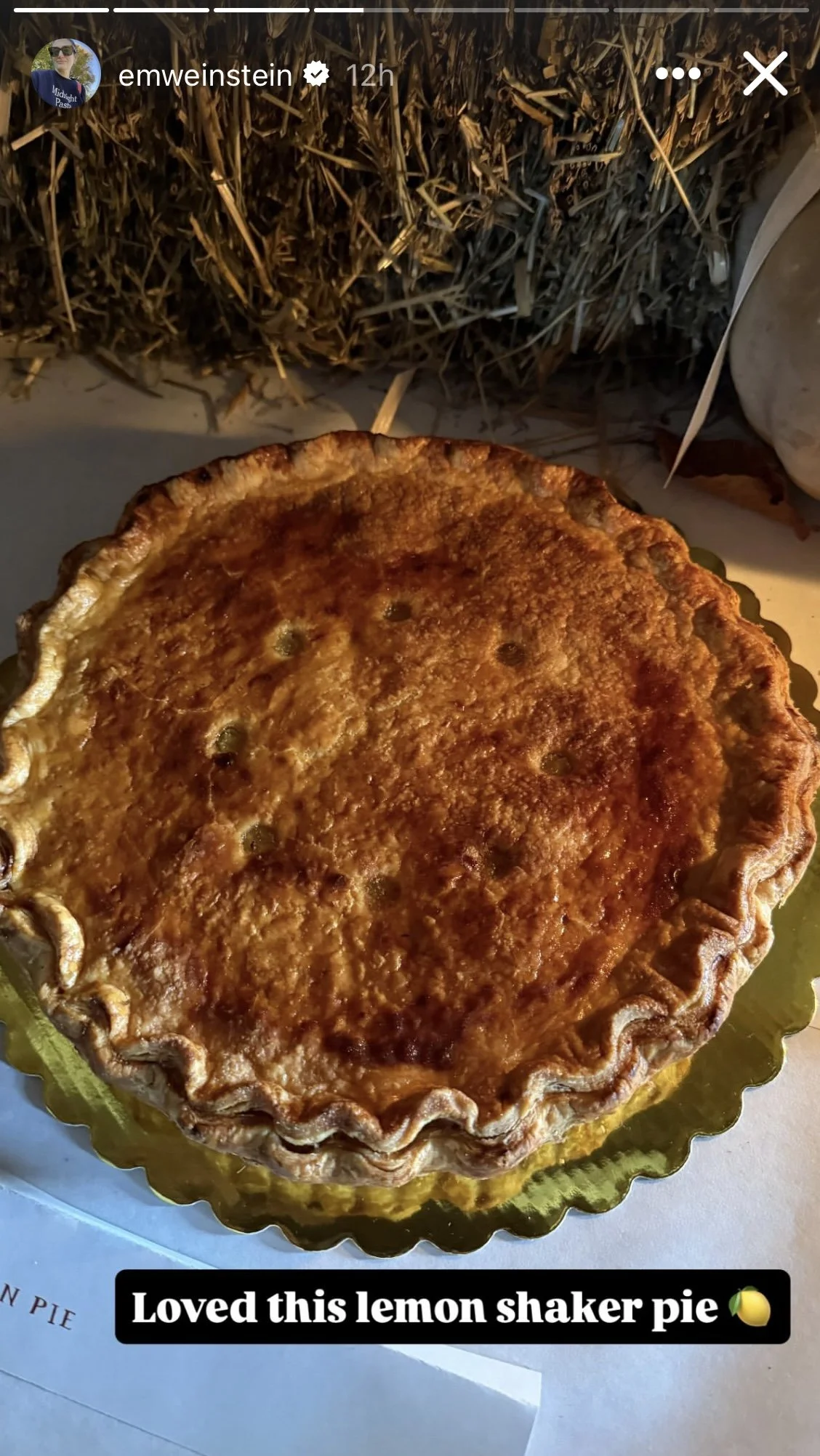
Editor-in-Chief of NYT Cooking & Food Emily Weinstein posted about just one pie, to my surprise and delight!
“There are no Shakers anymore, […] so to have this pie to celebrate that queer and unusual and memorable community of Shakers is very nice.”
— Martha Stewart
Shaker Lemon Pie
Lauren Hildreth, November 2025
Adapted from Tartine, by Elisabeth M. Prueitt and Chad Robertson, 2006.
Part marmalade, part curd, this pie typifies the thrift, ingenuity, and vision of the Shakers, coming together easily with just a couple of whole lemons, some sugar, and a handful of eggs. Its balance of tart and sweet makes it a seasonless pie that's both a welcome respite from the height of summer and a bright spot in winter's depths.
The prize-winning version of this pie uses both lemons and bergamot, a variety of orange whose scent will remind you of Earl Grey tea. The original recipe is perfectly wonderful with lemons only, as the Shakers would have done, but if you can find fresh bergamot, use it. If you can’t, replace it with lemons to total 225g. Meyer lemons are another nice option as well. Whatever fruit you choose, weigh it after slicing it.
Kitchen Note
Plan for two days of prep time from the day you plan to serve your pie. The recipe is not terribly complicated, but the citrus and pastry dough need ample time on their own for gluten and sugar to do their work. I typically make the pastry dough and prep the lemons two nights before, bake the next day, and serve on the third.
Avoid any aluminum tools or equipment, as it will react with the citrus, giving it an unpleasant metallic flavor.
The success of this pie turns on the quality and handling of the citrus. Choose the best fruit you can find, looking for citrus with very thin skins.
Chill them well to firm them up before slicing.
If at all possible, use a mandoline. If not, use a freshly sharpened knife. If you have neither of these, consider making a different recipe, or building in time for the inevitable trip to urgent care.
Ingredients
200g whole lemon, sliced paper-thin (from about 2-3 lemons)
25g whole bergamot (from one bergamot), sliced paper-thin, then minced
295g granulated sugar
2 Flaky Tart Dough rounds, each 12 inches in diameter (see recipe below)
5 large eggs
1ml or 1/4 tsp Diamond Crystal salt
30ml or 1 tbsp heavy cream
superfine sugar, to decorate
softly whipped cream, slightly sweetened, to serve
Advance Prep
Pies want to be very cold right up until the moment you bake them, so see which ingredients you can chill in advance. At least a day ahead, put the citrus in the fridge, and cut the butter for the pastry and freeze it. You can even mix the water and salt for the pastry and keep that in the fridge until needed. The pastry benefits from resting a while, so consider making it a day before you’re ready to bake.
8-12 HOURS AHEAD
Macerate the citrus
Cut off one end of a chilled lemon and use a mandoline to slice it paper-thin, discarding any seeds. Roughly chop so that no piece is more than about an inch long. Repeat with the bergamot, and then mince very finely until it verges on a paste.
Place the citrus in a nonreactive bowl (stainless steel or glass) and, using a spoon or your hands, toss with the sugar. Cover and let sit at room temperature for at least 8 hours or up to overnight. If any seeds are still left, they will usually float to the top where they are easily fished out.
If you are using more tender-skinned Meyer lemons, you can proceed to the next step without letting them sit, as the skins don't need the sugar to tenderize them.
2-24 HOURS AHEAD
Prepare and chill the pastry
See recipe for Flaky Tart Dough below.
BAKE DAY
Prepare the filling
In a bowl, whisk the eggs and salt together until blended. Pour about 2 tbsp. of the mixture into a small dish and set aside for the egg wash later. Thoroughly mix the remaining egg-and-salt mixture with the citrus-sugar mixture. Chill in the fridge while you prepare the bottom crust.
Assemble the pie (and keep it cold)
Use one 12-inch pastry round to line a 10-inch nonstick tart pan with a removable bottom, easing it into the bottom and sides and leaving a 1-inch overhang. Chill while you prepare the top crust.
Once you’ve rolled out and cut the top crust, cut vents into it using a knife or very small cookie cutters. Chill on a parchment-lined cutting board or sheet pan.
To make the egg wash, whisk the reserved 2 tbsp. of egg-and-salt mixture with 1 tbs. of heavy whipping cream.
Remove the pan with the bottom pastry from the fridge and brush the top edge—both inside and out—with egg wash. This lets you better control the egg wash and prevent it from pooling messily. Pour the prepared citrus-egg mixture into the crust. It will be very liquid, so you must evenly distribute the pieces in the pan.
Take the top pastry round from the fridge and brush egg wash on the outer edge, going about an inch-and-a-half in. Carefully flip over (use a rolling pin to help support it) and brush the entire round with egg wash.
Lay this pastry round over the filling and trim the overhang for both rounds to 1/4 inch. Crimp the edge as you would for a pie, making sure you have a good seal. Brush the crimped crust once more with the egg wash, being sure every surface is covered but not soggy. Sprinkle liberally yet evenly with superfine sugar. Chill for about 30 minutes. (Chilling the assembled pie firms up the pockets of butter in the dough so that when the pie goes into the oven, the butter will melt, creating the flaky texture you want in your finished dough.)
Bake the pie
While the pie is chilling, position a rack in the lower third of the oven and preheat to 450ºF. Line a baking sheet with parchment paper.
Place the chilled pie on the lined baking sheet. Bake on the bottom rack for 10-15 minutes or until the crust has stopped rising and has begun to take on color.
Lower the temperature to 375ºF and continue baking for 30-45 minutes, until the crust is deep gold and you can see the filling bubbling through the vents. If the top is browning too quickly, loosely place a piece of foil over the top. You can also move the pie to the middle rack if needed.
When the pie is done, let it rest on a cooling rack for 5-10 minutes, and then carefully remove it from the tart pan so that the steam can escape. (It will be very hot still!) Do this by placing the whole thing on top of a small bowl and allowing the ring to fall (you may have to help it off gently). Then place the pie on a cooling rack and gently but swiftly nudge it off of the metal round and onto the rack itself.
Let the pie cool completely before serving to allow the filling to set properly. Serve at room temperature with softly whipped, lightly sweetened cream. The pie will keep, covered, in the refrigerator or in a cool kitchen for up to 4 days.
To revive the crust nearly to its original bite, warm a slice in a 350ºF oven for about 10 minutes.

Flaky Tart Dough
Lauren Hildreth, November 2025
Adapted from Tartine, by Elisabeth M. Prueitt and Chad Robertson, 2006.
This recipe is great for any pie that uses a “regular” crust. The instructions here are general guidelines; follow the recipe above for notes specific to Shaker Lemon Pie. Getting this dough right depends on a light hand, a swift pace, and a cool environment. Handle it less than you feel you should and, if you feel like it’s all getting away from you, remember that you are in charge of the pie crust, not the other way around.
Kitchen Note
Another wonderful technique for making pie crust is fraisage. It entails using your hands or a rolling pin to smear the butter into the flour in order to create beautiful layers of pastry. It comes down to personal preference, but it’s a nice alternative to a food processor. Read more.
Wrapped tightly in plastic and aluminum foil and stored in a freezer bag, the prepared rounds of crust will keep frozen for two to three months. Defrost for a day in the fridge when ready to use.
Ingredients
5ml (1 tsp) Diamond Crystal salt
150ml (2/3C) very cold water
455g (1lb) all-purpose flour
300g (1C + 5tbsp) high-butterfat unsalted butter, cut into 1/2-inch pieces, frozen*
*Cut each stick of butter lengthwise, then crosswise into 1/2-inch pieces. You should have 16 pieces of butter.
Prepare the dough
To make the dough in a food processor:
In a small bowl, add the salt to the water and stir to dissolve. Keep very cold until ready to use.
Put the flour in the work bowl, and scatter the frozen butter pieces over the flour. Pulse briefly until the mixture forms large crumbs and some of the butter is still in pieces the size of peas. Gradually add the water-and-salt mixture and pulse for several seconds until the dough begins to come together in a ball but is not completely smooth. You should still be able to see some butter chunks, and it may look grainy. You know it’s ready when you can squeeze a clump of it and it holds together. If it’s not, add more water, a tablespoon at a time, until it is.
On a lightly floured work surface, divide the dough into 2 equal balls and shape each ball into a disk 1 inch thick. Wrap well in plastic wrap and chill for at least 2 hours or up to 24.
Roll out the pastry
To line the tart pan, place a disk of dough on a lightly floured surface and, using a tapered French rolling pin, roll out 1/8 inch thick, working from the center toward the edge in all directions. Lift and rotate the dough a quarter turn every few strokes to discourage sticking, and work quickly to prevent the dough from becoming warm. Lightly dust the work surface with extra flour as needed to prevent sticking. You should see faint streaks of butter throughout the dough.
Cut out a circle 2 inches larger than the tart pan. Carefully transfer the pastry round to the tart pan (drape the crust over the rolling pin to simplify the transfer), easing it into the bottom and sides and then pressing gently into place. The crust should be about an inch taller than the pan.
Before filling the pie shell, brush egg wash onto the top edge of the crust, both inside and out. This keeps the egg wash from mingling too much with the filling.
Chill the pastry-filled pan while you prepare the top crust in the same manner as before. Chill on a parchment-lined cutting board or pastry sheet while you prepare the filling. Brush the pastry with egg wash before covering the pie. You can cut any vents now, too.
Assemble the pie
Add the filling and cover with the second crust, aligning the edges of the top and bottom crusts with one another. Trim to 1/4 to 1/2 inch tall and crimp or flute the edge.
Brush the pie with additional egg wash to seal any spots you may have missed and (optionally) sprinkle liberally but not excessively with superfine sugar. Bake as directed.
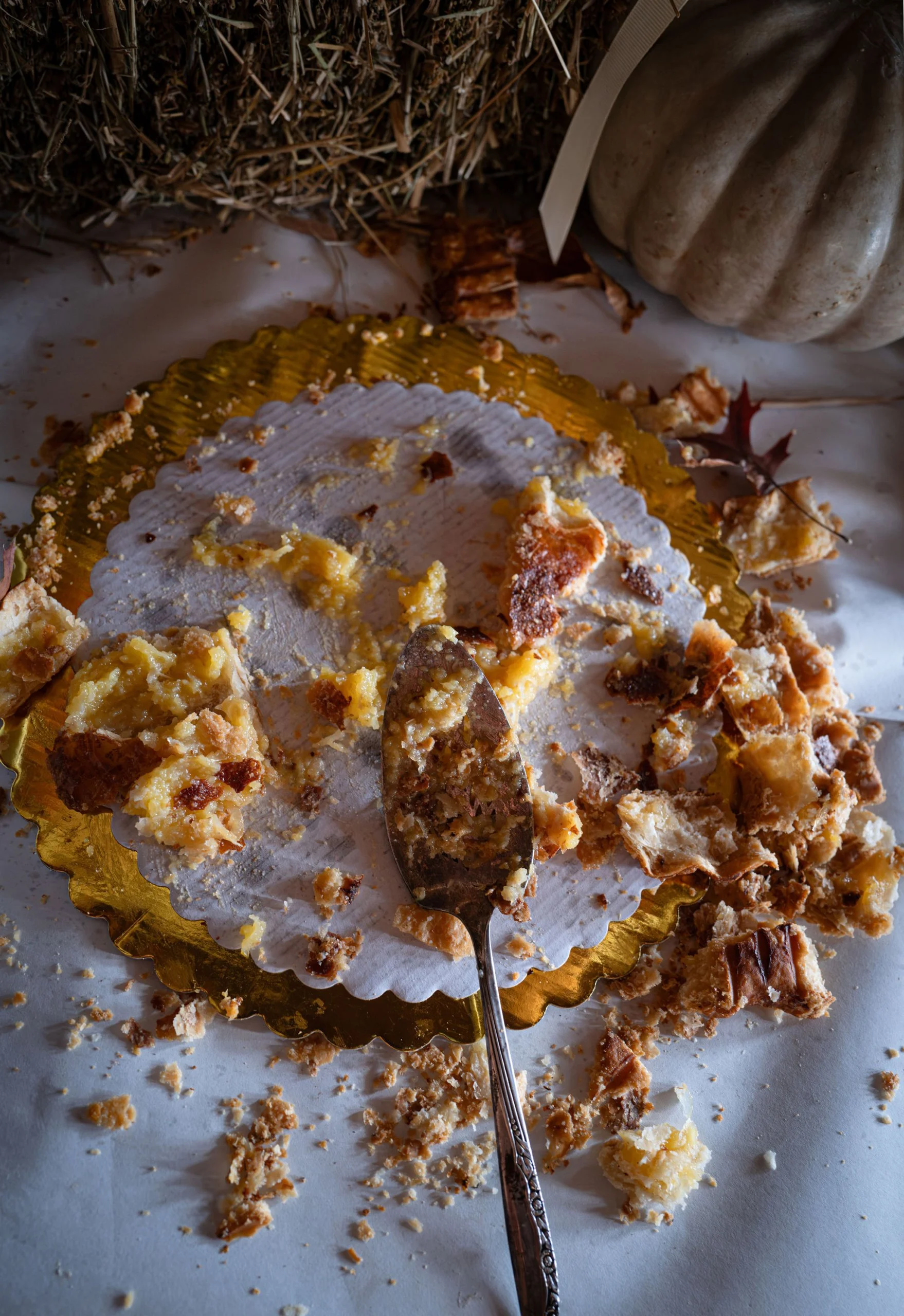
Photo by Olya Vysotskaya